

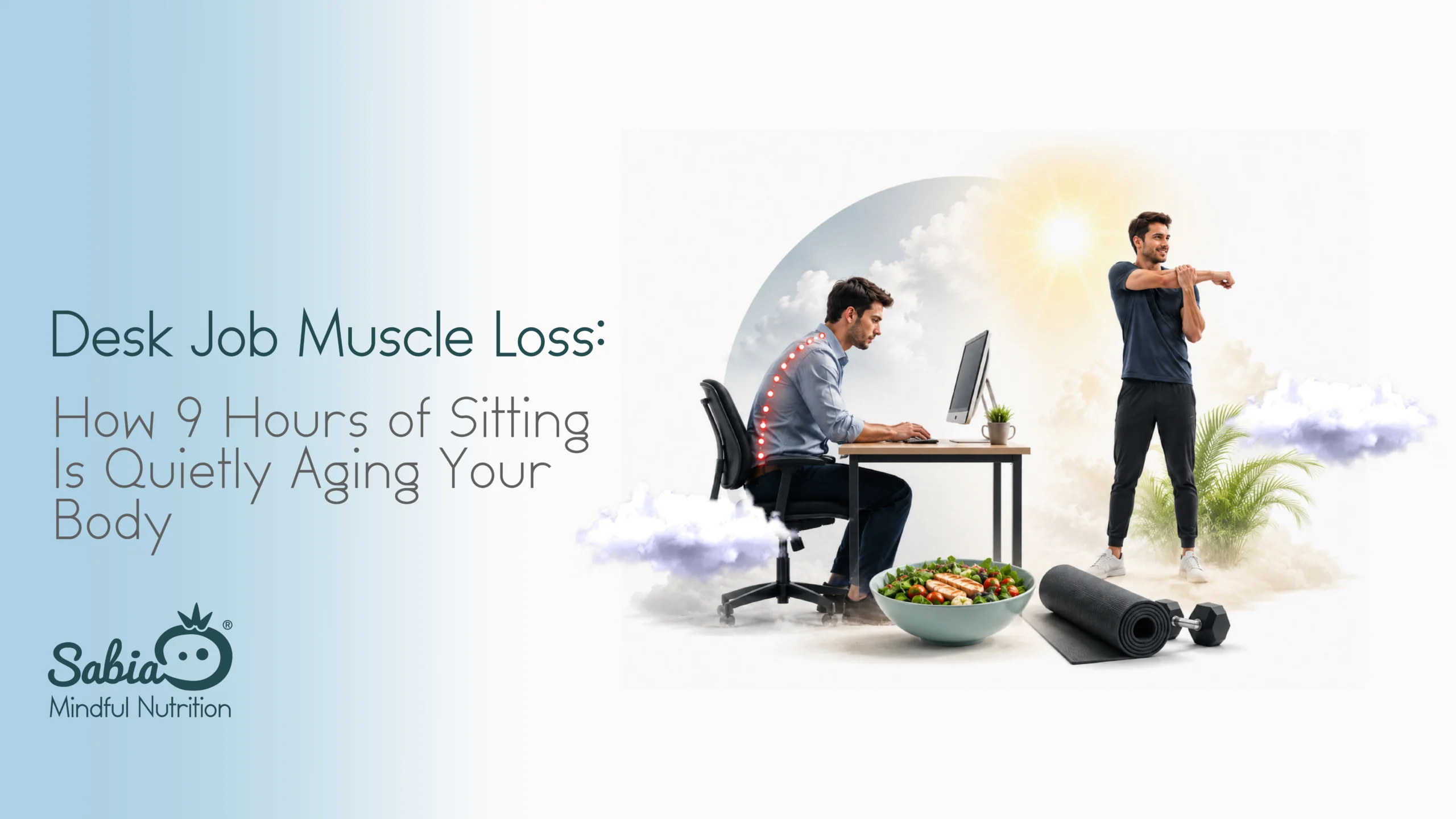
Desk Job Muscle Loss: How 9 Hours of Sitting Is Quietly Aging Your Body (And the Fix)
The Desk Job Body Is Becoming the New Health Warning Sign
Most people do not notice it happening. It starts with a little stiffness in the hips. Then your lower back feels tight after work. Your shoulders stay tense even after you close the laptop. Your energy drops in the afternoon. Your cravings get stronger at night. Your sleep gets shorter. Your waistline changes slowly, but the scale does not tell the full story.
This is the quiet health shift affecting millions of desk workers: muscle loss, reduced metabolic health, increased stress load, and gradual weight gain caused by the modern workday.
The problem is not just sitting. It is the combination of long sedentary hours, chronic stress, elevated cortisol, poor sleep, low protein intake, and minimal strength training. For many professionals in their 30s and 40s, this has become the default lifestyle pattern.
You wake up tired, drink coffee, sit for hours, answer messages under pressure, skip movement breaks, eat quickly, sit again, work late, feel mentally drained, sleep poorly, and repeat the cycle the next day. Over time, the body adapts — but not in the direction you want.
This article explains how a desk job can quietly accelerate muscle loss and make your body feel older than your age. More importantly, it gives you a practical fix: nutrition, movement, strength training, stress control, and sleep strategies that fit real life.
Why Sitting for 9 Hours Changes More Than Your Posture
Long sitting hours reduce muscle activity, especially in the glutes, hamstrings, hip flexors, core, and postural muscles. When muscles are not used regularly, they receive fewer signals to stay strong. This does not mean you lose muscle overnight, but over months and years, the body becomes less metabolically active.
Skeletal muscle is not just for appearance. Muscle is one of the most important tissues for glucose regulation, metabolism, posture, joint support, and long-term mobility. Less muscle means your body has fewer active tissues helping manage blood sugar and energy use.
A 2026 systematic review on prolonged static sedentary work among corporate desk employees noted that corporate workers commonly spend six to ten hours per working day in sustained sitting. The review also summarized physiological concerns such as vascular changes, reduced blood flow, metabolic disruption, and musculoskeletal strain.
Another major review on the physiology of sedentary behavior reported that excessive and prolonged sedentary behavior can contribute to insulin resistance, vascular dysfunction, reduced cardiorespiratory fitness, loss of muscle mass and strength, increased body fat, and inflammation.
In simple terms: your body was designed to move. When you sit for most of the day, your muscles stop acting like active engines and start acting like parked cars.

The Hidden Link Between Desk Jobs, Cortisol, and Muscle Loss
When stress stays high for long periods, it may interfere with sleep, increase cravings, reduce motivation to exercise, and make recovery harder. If you are also under-eating protein, skipping strength training, and sitting all day, the body has fewer reasons to preserve muscle.
This is why many professionals do not simply “gain weight.” They experience a body composition shift. Muscle decreases, fat increases, posture weakens, and metabolism feels slower. The number on the scale may rise gradually, but the bigger issue is what is happening beneath the surface.
For people in their 30s and 40s, this is especially relevant. This is the stage of life where careers intensify, stress increases, sleep often declines, and strength training gets replaced by “I’ll start next week.” The result is a silent aging effect: weaker muscles, lower energy, poorer recovery, and more stiffness.
Poor Sleep Makes the Problem Worse
Sleep is when the body repairs. It supports hormone regulation, appetite control, muscle recovery, immune function, and mental clarity. When sleep is consistently short or low quality, muscle maintenance becomes harder.
Research on sleep and muscle physiology suggests that poor sleep can negatively affect muscle protein synthesis, recovery, and hormonal balance. This matters because muscle is constantly being broken down and rebuilt. If your body does not get enough recovery time, the balance can shift in the wrong direction.
Desk workers often underestimate this. They think the problem is lack of workouts, but the real issue is the combination: not moving enough during the day, not sleeping enough at night, and not eating enough of the right nutrients to recover.
If you want to preserve muscle and feel younger, sleep has to be part of the strategy.
The 5 Warning Signs of Desk Job Muscle Loss
1. You Feel Weaker During Simple Daily Tasks
If carrying groceries, climbing stairs, or standing for long periods feels harder than it used to, your muscles may be losing strength.
2. Your Posture Is Getting Worse
Rounded shoulders, forward head posture, tight hips, and lower back discomfort are common signs that your postural muscles are underused and overstressed.
3. Your Waistline Changes Even Without Major Weight Gain
Muscle loss and fat gain can happen at the same time. This means the scale may not change dramatically, but your body composition does.
4. You Feel Tired Even After Sitting All Day
Sitting does not equal resting. Mental stress, poor circulation, and low movement can leave you feeling drained.
5. You Get Sore or Stiff Easily
Long sitting reduces mobility. Tight hips, stiff hamstrings, and back tension can become your new normal if you do not interrupt the pattern.
“`
The Fix: Build a Desk Job Muscle Protection Plan
The solution is not quitting your job or spending two hours in the gym every day. The solution is creating a realistic system that protects your muscle, metabolism, posture, and recovery.
1. Eat Protein at Every Meal
Protein gives your body the amino acids it needs to repair and maintain muscle tissue. For desk workers, protein is especially important because low activity plus low protein intake can accelerate muscle loss over time.
Good protein options include eggs, Greek yogurt, chicken, turkey, fish, tofu, tempeh, lentils, beans, cottage cheese, and protein-rich smoothies.
A simple Sabia-style plate would include:
- Protein: salmon, chicken, eggs, tofu, or Greek yogurt.
- Fiber: vegetables, berries, beans, oats, or quinoa.
- Healthy fats: avocado, olive oil, nuts, or seeds.
- Smart carbs: sweet potato, brown rice, quinoa, fruit, or whole grains.

2. Add Strength Training Twice a Week
Strength training is one of the most effective tools to protect muscle. The CDC recommends that adults do at least 150 minutes of moderate-intensity physical activity each week and at least two days of muscle-strengthening activity.
You do not need a complicated routine. Start with basic movements:
- Squats or chair squats.
- Push-ups or incline push-ups.
- Rows with bands or dumbbells.
- Glute bridges.
- Lunges or step-ups.
- Planks or dead bugs.
The goal is to give your muscles a reason to stay strong. Desk work tells your muscles to relax. Strength training tells them to adapt.
3. Use Micro-Movement Snacks During the Workday
Micro-movement snacks are short movement breaks that last one to five minutes. They are ideal for desk workers because they interrupt long sitting without requiring a full workout.
Try this every 60–90 minutes:
- 10 chair squats.
- 15 calf raises.
- 10 shoulder rolls.
- 30 seconds of marching in place.
- 30 seconds of hip flexor stretching.
These small breaks improve circulation, reduce stiffness, activate muscles, and help your body move out of “desk mode.”

4. Protect Sleep Like It Is Part of Your Fitness Plan
If you are sleeping five or six hours most nights, your recovery is compromised. You may still function, but functioning is not the same as thriving.
Try these sleep upgrades:
- Stop caffeine after early afternoon.
- Dim lights one hour before bed.
- Keep your bedroom cool and dark.
- Avoid heavy meals right before sleep.
- Use a consistent sleep and wake schedule.
- Create a 10-minute wind-down routine.
Better sleep supports better energy, better food choices, better workouts, and better muscle recovery.
5. Manage Stress Before It Manages Your Body
Stress is not just mental. It changes behavior. When stress is high, people often move less, sleep worse, snack more, drink less water, and skip workouts. The goal is not to eliminate stress completely. The goal is to build recovery into the day.
Simple tools include:
- Five minutes of breathing between meetings.
- A short walk after lunch.
- Stretching after work.
- Preparing meals ahead of busy days.
- Setting a clear shutdown time for work.
Your nervous system needs signals of safety. Movement, sunlight, hydration, and balanced meals are powerful signals.
A Simple 1-Day Desk Worker Reset
Morning
- Sunlight exposure for 5–10 minutes.
- Protein-rich breakfast: eggs with avocado, Greek yogurt with berries, or a protein smoothie.
- Walk for 5 minutes before starting work.
Workday
- Stand or move every 60–90 minutes.
- Drink water consistently.
- Eat a balanced lunch with protein, fiber, and healthy fats.
- Take a short walk after lunch.
Evening
- Strength training or a 20-minute walk.
- Balanced dinner with lean protein and vegetables.
- Reduce screens before bed.
- Sleep routine at the same time.
Eat enough protein. Move throughout the day. Strength train twice a week. Sleep better. Manage stress. Hydrate. Build meals that support your energy instead of draining it.
Your body is always adapting. The question is: are your habits making you stronger or slowly weaker?
References
- Frontiers in Public Health. Physiological Consequences of Prolonged Static Sedentary Work Among Corporate Desk Employees, 2026.
- Physiological Reviews. Physiology of Sedentary Behavior.
- CDC. Adult Physical Activity Guidelines.
- WHO Guidelines on Physical Activity and Sedentary Behaviour.
